Traveling with Medication That Falls Under the Opium Act

Disclaimer: please note this article is not intended as medical advise. Everything that is written here is based on personal experience. I am by no means a professional and circumstances can vary per country and per case. If you have any concerns over any and all health related issues in regards to traveling you should consult a registered health care professional at all times!
If you or someone in your family relies on prescription medication regulated under the Opium Act, traveling can feel like walking through a legal maze. The rules aren’t always easy to find, and one misstep can turn a dream trip into a stressful ordeal.
That’s exactly why I wrote this post. For over a decade, my family has navigated international travel while carrying meds like Concerta, Ritalin, and Risperidone. I’ve filled out Schengen certificates, obtained legalized medical declarations, and dealt firsthand with customs questions. Trial and error taught me the necessary steps.
In this guide, you’ll find everything you need to know:
- How to check whether your medication falls under the Opium Act
- What documents you’ll need in Schengen vs non‑Schengen countries
- What timing is realistic (yes, I’ll share how long we take)
- Tips for staying healthy on the road with kids
This is not medical, nor is it legal advice, but it is a roadmap based on real, repeated experience. Bookmark this, refer back to it, and always double check with official sources before you travel. Let’s get you ready to move with confidence.
No time to read?
Save on Pinterest and read this article later!

Please keep in mind, that if you are in doubt if what I write here is applicable to your situation, please consult your country’s ministry of General Affairs and the embassy of the country or countries you will be visiting. Always double check your resources, to be sure you are taking the right and necessary steps. Traveling with medication that falls under the Opium Act is a tricky thing that you should research beforehand thoroughly!
Traveling with prescribed medication
We all bring medication along. The most popular ones being paracetamol and melatonine. You can easily take those abroad and customs won’t even blink. Unfortunately some of us have to take medication on a daily basis and that means taking prescribed drugs with you while traveling. In most cases it’s enough to go to your general practitioner or pharmacy and ask for a medication passport.
Do your research
But some kind of meds can’t be brought without some sort of medical declaration. And in some cases the meds you use on a frequent basis in your own country are strictly forbidden in others. So before booking a flight, renting a car or hopping on a train, do some research. Hopefully this blog post will help you, so you know what steps you’ll need to take next.
In our family two of us take Concerta, another one takes Ritalin and one of us also takes Risperidon. So we have a lot of experience with filling in the right forms and getting those forms legalized before we go on a trip.
Now keep in mind that we live in The Netherlands, so some of the links lead to official documents on Dutch websites. The info you should fill in is the same everywhere, but the forms might look slightly different. So always check with your own Ministry of Foreign Affairs to see if the form you should use differs from the one I lead you to.
Check if your medication falls under the Opium Act
First check if the medication that you and/or a family member takes is listed on the consult lists I and II of the Opium Act. You can google that easily. In our case we know that Concerta and Ritalin fall under the Opium Act and Risperidon doesn’t. The only action we have to take to bring Risperidon with us is to get a medication passport and bring it along. This passport will state the type of medication, why you have to take it and the dose prescribed to the patient. You can get this medical passport at your pharmacy or your general practitioner.
Concerta and Ritalin both contain methylphenidate, which falls under the Opium Law. Let me take our own prescribed meds as an example in this post. I’ll fill you in on how we’re able to go traveling with medication falling under the Opium Act when we visit Schengen countries and non-Schengen countries.

Packing 3 passports
While traveling we always bring along our ID, in most cases a passport. You can’t travel to another country without it. But we also take along two other passports on our trip.
Medication passport
This is not a legalized passport. It’s a document you can get from your general practitioner or your local pharmacy. If you lose your meds while traveling you can show the pharmacy in the country you’re visiting what you need and if you’ve got a prescription with you or if it’s available without a prescription you’re hooked up in minutes.
Please note that if you’ve lost medication that falls under the Opium Act, it depends on the country if they’ll help you or not. So take extra good care of those while traveling.
Vaccination passport
We also always bring our vaccination passport. Some countries want proof of the vaccinations you’ve gotten. And if you suddenly get sick and have to visit a hospital, they’ll want to know if you’re vaccinated, so they can rule out certain viruses.
Digital passports
Lastly, while we still bring along our hardcopies, there are lots of medication and vaccination apps you can download on your phone. In both cases it’s important to check if the apps are official and accepted worldwide as proof.
Traveling with medication under Opium Act to one or more Schengen countries
The first thing you need to do is fill in a Schengen certificate, which is a type of medical declaration. If you live in The Netherlands download the latest copy of this certificate from the website of the CAK. If you live in another Schengen country google the words Schengen certificate in your own language and you will surely find it.
If available you should download the English version rather than one in your own language. One in your own language will work though. The back of the form contains the English translations, but it could take you a bit longer at customs.
The next step is that you fill in your own personal info and info about your medication and dose. Let your general practitioner fill in the rest, sign and stamp the form. If you’ve done this then you should send the original document or email a copy to the institution that you’ve downloaded the form from, in my case the CAK. They will check if everything is filled out ok and legalize the document. They will send the form back to you with a stamp, date of legalization and a signature.


This next step is not particularly necessary but you better be safe than sorry. I always call the embassy of the country I’m visiting to check if this is enough. I never had to take an extra step, but I will keep on calling before every trip to a Schengen country. Why? Because if it turns out that I’ve missed a step than in the best case we’d have to sit in a separate room at the airport getting briefed by customs while they check if everything is fine. In the worst case they’ll take us in because they think you’re trying to import drugs into their country. And that’s a situation that no one wants to be in.
In The Netherlands I start filling in the forms 8 weeks in advance. Filling in the form myself and getting the general practitioner to take action for us takes up around a week. Sending the form to CAK will take a maximum of two weeks (but I’ve always received them within a week). So I’m all done 4 to 5 weeks before the trip and if I ever have to go to an embassy (only at their request) I have enough time to get over there for a stamp. By the way, that will set you back a penny, they never legalize any document for free.
Validation Schengen Medical Certificate
Other things you should know is that a certificate is only valid for 30 days and for a maximum of four Schengen countries. If you want to stay longer (between 31 and 90 days) you should use multiple Schengen certificates and if you want to stay for over 90 days, well then you need a Medical Declaration in English. This is the form you also need to use if you live in a Schengen country and you will travel to an non-Schengen country.
Do
- take your medication and medical declarations with you in your carry-on so you can show both to customs;
- keep your pills in their original package so customs can easily see what you’re bringing.
Don’t
- keep any loose pills in your carry-on or checked-in bags. If found they will have to perform a drug test and it will be positive which will cost you precious time explaining that these are the pills that are prescribed legally to you;
- make jokes to customs about bringing drugs with you (for the same reasons you can’t joke about bringing bombs on board).
Traveling with medication under Opium Act to one or more non-Schengen countries
As I mentioned above you need a Medical Declaration in English to visit countries outside of the Schengen area. You have to take more steps than with a Schengen certificate so start as soon as you can. Ideally a few months in advance. First call the embassy of the country or countries you’ll visit. Ask them what border control needs to let you safely enter their country. I always get the same answer. They want you to visit their embassy or consulate, so they can legalize your Medical Declaration after you’ve taken all other steps first.
First go to the International Narcotics Control Board and find your destination to double check the rules regarding import of your meds. After that download an empty medical certificate from the institute that your government assigned the duty of taken care of consular issues. Fill it in and again go to your general practitioner for his/her signature and stamp.

After that go to the institute that handles consular issues in your own country to get your form legalized by them. It might be a possibility to arrange this via mail, but I don’t want the form to get lost and want to get this step handled as fast as I can, so I always go and get the stamp (or in the case of The Netherlands: a sticker) myself. In The Netherlands I have to pay a fee for this step (15 euro per document). You need to bring an ID with you or else you’ll get send home without a legalized document.
Next, visit the consulate(s) or embassy(ies) of the country or countries you’re traveling to and get a stamp there. Again: bring your passport. The cost for this step depends on the country you are going to. Every country asks for a different fee. It can quite hefty. I’ve seen everything from €25 per stamp to €75 per stamp.
That’s it! You’re done and you’ve ended up with a document with multiple stickers and/or stamps.
How to stay healthy traveling with kids
Traveling with medication is one of the topics you should think about when traveling with kids. Keeping your kids safe and healthy is the top priority for every parent. That’s why you should also make sure you have travel insurance covering costs like repatriation in case of an accident, visits to (private) hospitals when one of you gets sick, medication you might need if something happened while on the road, etc.
Get my FREE pocket guide >> How to Stay Healthy Traveling with Kids
Final thoughts on traveling with medication that falls under the Opium Act
Traveling with medication that’s regulated under the Opium Act can feel daunting, but it doesn’t have to be. With the right paperwork, planning, and preparation, you can confidently bring the meds your family needs and focus on enjoying the journey.
After 15 years of navigating these requirements with my own family, I’ve learned that staying organized and informed is everything. Always double-check the latest rules, start early, and when in doubt: call the embassy.
✨ Want more tips on staying healthy during family travel?
👇 Grab my free pocket guide 👇
🎒 FREE Pocket Guide for Parents
Keep your family safe and healthy on the road!
Download my practical, parent-tested pocket guide:
🩺 How to Stay Healthy Traveling with Kids
✅ Essential tips
✅ Packing checklists
✅ Real advice from 15+ years of family travel
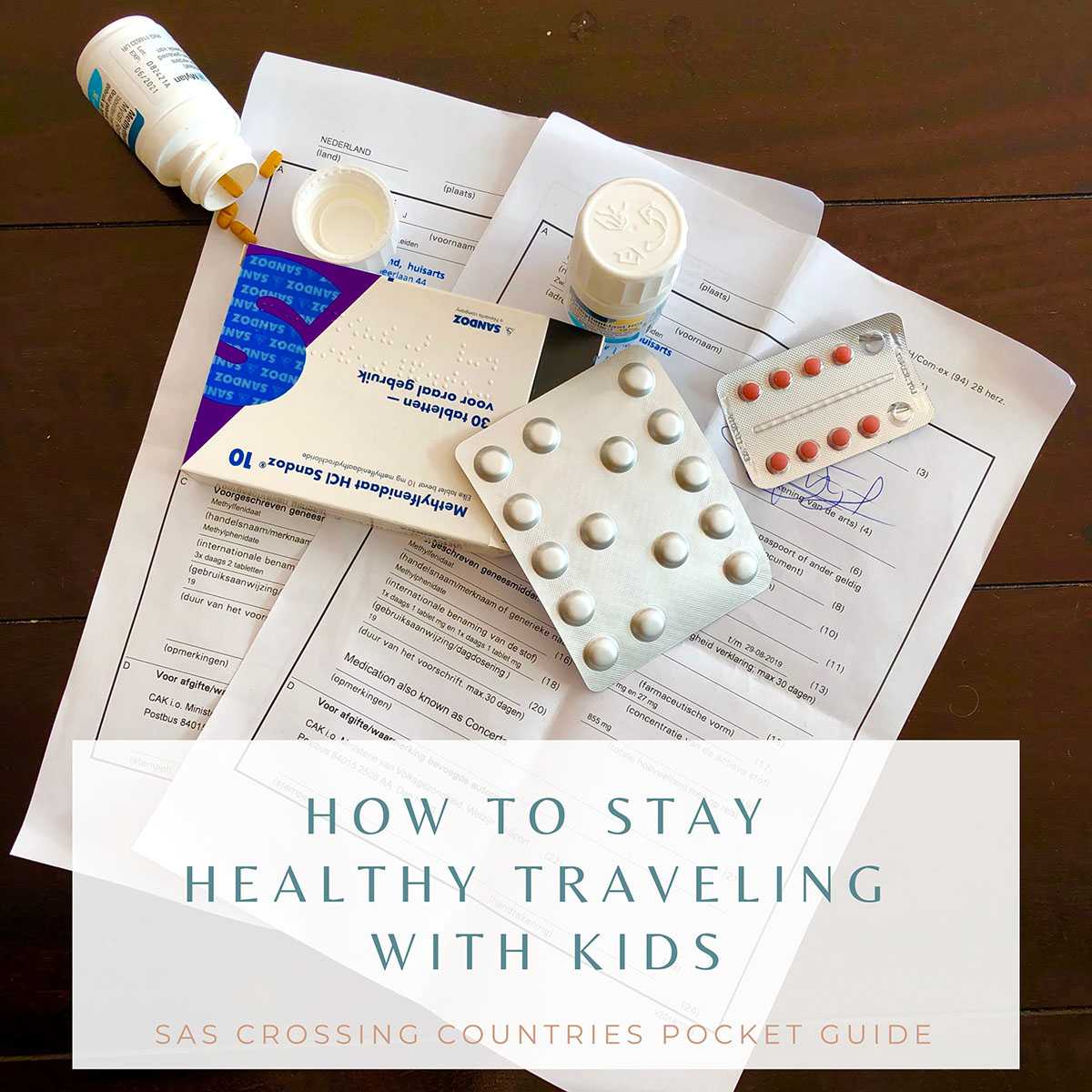
👉 Download How To Stay Healthy Traveling with Kids – packed with real-life advice from our own adventures and designed to keep your whole crew safe, comfortable, and happy on the road.
Did you enjoy Traveling with Medication that Falls under the Opium Act?
If so, read more family travel tips:
- How To Plan A Family Road Trip
- Family Travel Insurance: What It Covers & Why It’s a Must
- Traveling with medication that falls under the Opium Act
- Wildlife Tourism: How To Help End Animal Abuse in Tourism
- Why Your Family Needs an eSIM for Travel: Is an eSIM Worth It?
- The Art of Balancing: Why I Travel Solo Once a Year
Pin for Later

Other Family Trip Planning Posts